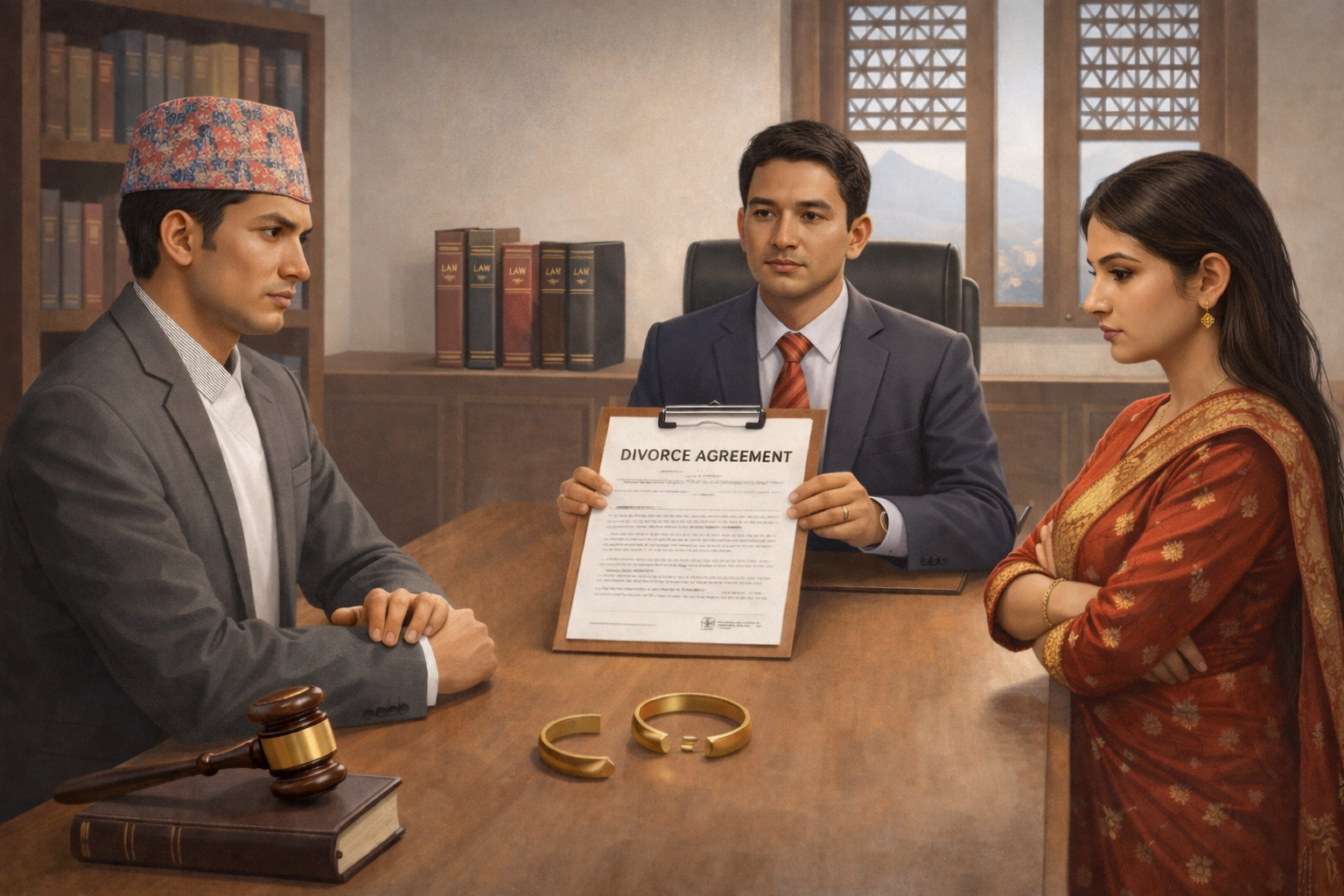
Mutual Consent Divorce in Nepal: Process, Agreement & Timeline (2-3 Days)
Direct Answer:

Quick Answer: Mutual consent divorce is the fastest, cheapest way to legally end marriage in Nepal, taking 2-3 days and costing Rs. 15,000 - 30,000 < /strong>. Both spouses must agree on all terms (property, custody, support), draft a comprehensive settlement agreement, and file jointly at District Court. The process is non-adversarial, private, and preserves amicable relations—ideal for couples who simply grew apart.
Why Choose Mutual Consent Divorce ?
⚡ Speed
2 - 3 days < /strong> vs 6-18 months for contested divorce
💰 Cost
Rs. 15K - 30K < /strong> vs Rs. 50K-150K+ for litigation
🔒 Privacy
No public airing of marital disputes
🤝 Control
You decide terms, not judges
👨👩👧👦 Co - Parenting
Preserves ability to co - parent amicably
🧘♀️ Less Stress
No court battles, witness examinations
Legal Basis: Section 95, Civil Code 2074
"If husband and wife mutually agree to dissolve the marriage, the Court shall effect divorce upon making necessary inquiry."
Key Legal Points:
- Mutual agreement is sufficient ground—no blame needed
- Court must verify free consent < /strong> (no coercion)
- Judge ensures agreement is fair and complete < /strong>
- Children's welfare paramount consideration
- Decree is final and binding(res judicata)
Eligibility Checklist for Mutual Divorce
✅ You Qualify If:
- ☐ Both spouses agree to end marriage
- ☐ Both are 20 + years(legal marriage age)
- ☐ Marriage was legally registered / valid
- ☐ Both can appear in court(or valid POA)
- ☐ You agree on ALL major issues:
- Property division
- Child custody(if applicable)
- Child support
- Alimony(if any)
- Debts
❌ You Don't Qualify If:
- ☐ One party doesn't want divorce
- ☐ You cannot agree on property or custody
- ☐ One party is mentally incapacitated
- ☐ Marriage was void (underage, bigamous)
- ☐ Domestic violence ongoing(safety concerns)
The Mutual Divorce Process: Step - by - Step
Phase 1: Pre - Filing Preparation(1 - 2 weeks)
< h4> Step 1: Initial Discussion & Decision(Day 1 - 3)Have honest conversation about:
- Is reconciliation impossible ?
- Can we communicate civilly to negotiate ?
- Are we both committed to amicable process ?
- Do we understand this is irreversible ?
Both parties must fully disclose:
| Category | Documents Needed |
|---|---|
| Real Estate | Lalpurja(land ownership), house registration, valuation |
| Bank Accounts | All account statements(joint and individual) |
| Investments | Shares, bonds, fixed deposits, insurance policies |
| Retirement | Provident fund, pension accounts |
| Vehicles | Blue book, valuation |
| Business | Company registration, profit / loss statements |
| Debts | Loans, credit cards, mortgages |
| Income | Salary slips, tax returns, business income |
Consequences of Hiding Assets: If hidden assets discovered later, agreement can be challenged for fraud. Full disclosure essential.
Step 3: Negotiate Terms(Day 8 - 12)
Use this framework:
Property Division Matrix:
| Asset | Value | Husband | Wife | Method |
|---|---|---|---|---|
| Marital Home | Rs. 50L | Keeps | Gets Rs. 25L cash | Sell or buyout |
| Car | Rs. 8L | - | Keeps | Direct transfer |
| Bank Savings | Rs. 5L | Rs. 2.5L | Rs. 2.5L | 50 - 50 split |
| Husband's PF | Rs. 12L | Keeps | Rs. 6L alimony | Offset |
Engage lawyer to draft Mutual Divorce Agreement < /strong> including:
Section 1: Parties & Marriage Details
- Full names, addresses, citizenship numbers
- Marriage date and registration details
- Children details(names, ages)
- Mutual agreement to dissolve marriage
- No coercion or undue influence
- Irretrievable breakdown acknowledgment
- List every asset with description and value
- Clear allocation: "Husband keeps [asset], Wife keeps [asset]"
- Timeline for transfers(within 30 / 60 / 90 days)
- Tax responsibility allocation
- Physical custody(where children live)
- Legal custody(who makes decisions)
- Visitation schedule(weekends, holidays, vacations)
- Child support amount, payment date, method
- Education / medical expense sharing
- College fund provisions
- Amount(lump sum or monthly)
- Duration
- Termination conditions(remarriage, death)
- Who pays which loan
- Credit card responsibility
- Mortgage assumption
- No future claims on each other
- Life insurance beneficiary changes
- Will revisions
- Dispute resolution(mediation for post - divorce conflicts)
- Confidentiality clause
- Entire agreement clause
- Severability clause
- Governing law(Nepal)
- Both parties
- Two witnesses(preferably family members)
- Lawyer notarization
Phase 2: Court Filing(1 day)
< h4> Step 5: Document Assembly- ☐ Mutual Divorce Petition(joint application)
- ☐ Settlement Agreement(4 copies)
- ☐ Marriage Certificate
- ☐ Citizenship certificates(both)
- ☐ Citizenship of 2 witnesses
- ☐ Photos(passport size, both parties)
- ☐ Children's birth certificates (if applicable)
- ☐ Court fee: Rs. 500
- ☐ Power of Attorney(if one party cannot attend all hearings)
Location: Family Division, District Court where:
- Marriage was registered, OR
- Parties last resided together, OR
- Wife currently resides
Time: 9:00 AM - 10:00 AM (avoid crowds)
Process:
- Submit petition at filing counter
- Pay court fee
- Get case number
- Judge assigned
- Hearing date set(usually same day or next)
Phase 3: Judicial Process(1 - 2 days)
< h4> Step 7: First Hearing - VerificationBoth parties appear before judge for:
Mandatory Judicial Inquiry:
- Identity Verification: Judge checks photos and IDs
- Consent Verification:
- "Do you both agree to divorce of your free will?"
- "Has anyone forced or coerced you?"
- "Do you understand this is final?"
- Understanding Check:
- "Have you read the agreement?"
- "Do you understand the property division?"
- "Do you understand custody arrangement?"
- Child Welfare Check(if children):
- "What is in the best interest of the children?"
- "Is the custody arrangement workable?"
- "Is child support sufficient?"
- Cooling - off(Sometimes):
- Judge may suggest 1 day reflection period
- Return next day to confirm decision
If judge satisfied:
- Signs divorce decree immediately or next day
- Issues certified copies
- Registers dissolution
Total Timeline: 2-3 days from filing to decree
Cost Breakdown: Mutual Consent Divorce
| Expense | Cost(Rs.) | Notes |
|---|---|---|
| Court filing fee | 500 | Mandatory government fee |
| Lawyer fees(drafting + appearance) | 10,000 - 25,000 | Varies by lawyer experience |
| Agreement notarization | 500 - 1,000 | Per document |
| Document copies / photos | 500 - 1,000 | Miscellaneous |
| Transportation | 1,000 - 3,000 | Multiple court visits |
| Total < /strong> | 15,000 - 30,000 < /strong> | Much cheaper than contested |
Sample Mutual Divorce Agreement Template
MUTUAL CONSENT DIVORCE AGREEMENT < /strong>
This Agreement made on[Date] at[Place]
BETWEEN < /strong>
Mr. [Husband Name], aged [Age], Citizen of Nepal, residing at [Address], Citizenship No. [Number] (Hereinafter "First Party")
AND < /strong>
Ms. [Wife Name], aged [Age], Citizen of Nepal, residing at [Address], Citizenship No. [Number] (Hereinafter "Second Party")
RECITALS:
- The parties were married on[Date] at[Place] as per[Custom/ Law]
- The marriage was registered at[Office] on[Date]
- Due to irreconcilable differences, parties wish to dissolve marriage mutually
- Parties have agreed to terms set forth herein
TERMS:
1. MUTUAL CONSENT: Both parties agree to dissolve marriage through mutual consent under Section 95, National Civil Code 2074.
2. PROPERTY DIVISION:
- The marital home at[Address] valued at Rs. [Amount] shall be[transferred to Wife / sold and proceeds divided 50 - 50 / retained by Husband who pays Wife Rs.X]
- Vehicles: [Description] to[Party]
- Bank accounts: [Details of division]
- Jewelry: [Details]
- Each party keeps personal belongings and premarital assets
3. CHILD CUSTODY: [If applicable]
- Physical custody of[Child Name], age[X], to[Mother / Father]
- Visitation: [Every weekend / Alternate weeks / Holidays]
- Legal custody: Joint / Both parties consult on major decisions
- Child support: Rs. [Amount] monthly, paid by[Date] to[Account]
- Education / Medical: Shared 50 - 50 or as [specified]
4. ALIMONY: [If applicable] [Party] pays [Party] Rs. [Amount] as [lump sum/monthly for X years]. Terminates upon remarriage of recipient.
5. DEBTS: [Party] assumes loan of Rs. [Amount] from [Bank]. [Party] responsible for credit card [Number].
6. NO FURTHER CLAIMS: Parties release each other from all future claims.
7. CONFIDENTIALITY: Parties agree not to disclose terms publicly.
SIGNATURES:
____________________
First Party(Husband)
Date:
____________________
Second Party(Wife)
Date:
WITNESSES:
1. ____________________(Name, Address, Citizenship)
2. ____________________(Name, Address, Citizenship)
Property Transfer After Divorce: Practical Steps
Once decree is issued, execute property transfers:
For Real Estate:
- Execute deed of gift or sale(as per agreement)
- Pay registration fee(4 - 6 % of property value for gift, 1 % for family transfer in some municipalities)
- Register at Land Revenue Office(Malpot)
- Update Lalpurja(land ownership certificate)
- Complete within 35 days to avoid penalties
For Vehicles:
- Transfer blue book at Yatayat Karyalaya
- Pay transfer fee
- Update insurance policy
For Bank Accounts:
- Close joint accounts
- Transfer agreed amounts
- Remove ex - spouse as nominee from individual accounts
Common Pitfalls to Avoid
❌ Pitfall 1: Vague Language
Bad: "Wife gets fair share of savings"
Good: "Wife receives Rs. 2,50,000 from Account No. XXXX at [Bank] within 30 days"
❌ Pitfall 2: No Tax Planning
Property transfers may trigger taxes.Consult tax advisor on optimal transfer methods(gift vs.sale).
❌ Pitfall 3: Ignoring Retirement Accounts
Provident fund, pensions, and insurance must be addressed.Get NRB approval for foreign transfers if applicable.
❌ Pitfall 4: No Enforcement Mechanism
Include clause: "If payment not made within X days, [consequence]" to ensure compliance.
❌ Pitfall 5: Forgetting Digital Assets
Include cryptocurrencies, online business accounts, domain names in property list.
❌ Pitfall 6: Not Updating Beneficiaries
Post - divorce, update life insurance, EPF, and will beneficiaries immediately.
When Mutual Divorce Becomes Contested
Sometimes mutual consent fails mid - process:
Scenario 1: Last - Minute Disagreement
Solution: If filed but agreement breaks down, convert to contested or withdraw and refile later.
Scenario 2: Non - Compliance with Agreement
Solution: File execution petition to enforce terms. Agreement is enforceable court decree.
Scenario 3: Discovery of Hidden Assets
Solution: Can challenge decree within 1 year on fraud grounds if assets deliberately concealed.
Post - Divorce Checklist
- ☐ Update citizenship status(change marital status at DAO)
- ☐ Change name back to maiden name(if desired) - requires court order
- ☐ Update passport(if name changed)
- ☐ Remove ex - spouse from:
- Bank account nominees
- Insurance policies
- Provident fund nominations
- Property co - ownership
- ☐ Update will and estate planning
- ☐ Inform employer(for benefits, emergency contacts)
- ☐ Update property mutation(दर्ता बुझाउने) at ward office
- ☐ Close joint credit cards / accounts
- ☐ Establish independent financial identity
- ☐ Seek counseling if needed(divorce is traumatic even when amicable)
Conclusion
Mutual consent divorce offers a dignified, efficient exit from marriage when both parties agree it's over. The 2-3 day timeline and reasonable costs (Rs. 15K-30K) make it accessible, while the ability to craft your own terms provides control impossible in contested litigation.
Success depends on complete financial disclosure, fair negotiation, and comprehensive agreement drafting < /strong>. While DIY divorce is possible, professional legal guidance ensures your agreement is enforceable and protects against future disputes.
Remember: The goal isn't just ending the marriage, but starting the next chapter of life on solid legal and financial footing. Invest time in getting the agreement right—it pays dividends for years to come.
Frequently Asked Questions
Q.How fast is mutual consent divorce in Nepal?
Mutual consent divorce in Nepal is the fastest legal method, taking just 2-3 days at District Court. Day 1: Document preparation and filing. Day 2: Judge interview and verification. Day 3: Divorce decree issued. This compares to 6-18 months for contested divorce.
Q.What should be included in mutual divorce agreement?
A mutual divorce agreement in Nepal must include: (1) Property division list (who gets which assets), (2) Child custody arrangement (physical and legal custody), (3) Child support amount and payment schedule, (4) Alimony/maintenance (if any), (5) Debt allocation, (6) Living arrangements, (7) Future dispute resolution method, and (8) Both parties' signatures with witnesses. Without these terms, court may reject the petition.
Q.Can we do mutual divorce without lawyers in Nepal?
Technically yes, but not recommended. While you can draft your own agreement and file at court, risks include: (1) Agreement may be legally incomplete or unfair, (2) Court may reject improper documents, (3) Property transfer may face tax issues, (4) Future enforcement problems if terms unclear. Lawyer fees (Rs. 10K-25K) are small compared to risks of DIY divorce.
Q.What if we agree on divorce but not on property?
If you agree on divorce but disagree on property division, you have two options: (1) File for mutual consent divorce with 'property division pending' clause, then handle property separately (risky), or (2) Convert to contested divorce for property issues while keeping other terms mutual. Best approach: Resolve property through mediation before filing to keep process fast and amicable.
Q.Is mutual divorce possible if we have children?
Yes, mutual consent divorce is very possible with children and often better than contested divorce. You must agree on: (1) Custody arrangement (joint or sole), (2) Visitation schedule for non-custodial parent, (3) Child support amount (typically 15-25% of income), (4) Education and medical expense sharing, and (5) Decision-making authority. Court will verify child welfare before approving.
Q.Can mutual divorce be challenged or reversed later?
Generally no, mutual consent divorce is final and binding once court decree is issued. However, limited grounds for challenge exist: (1) Fraud or coercion during agreement signing, (2) Discovery of hidden assets not disclosed, (3) Failure to follow agreement terms (enforcement issue, not reversal), (4) Child welfare concerns (custody modification possible). File challenge within 1 year of decree on fraud grounds.